Showing posts with label Tamo. Show all posts

Tuesday, April 25, 2023

From Chan to Zen


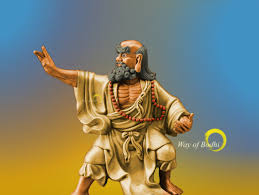
 Cha or Chan Buddhism traveled from China to Japan somewhere in the neighborhood of 500 years before the current era (BCE).  Chan Buddhism, also called Mahayana Buddhism traveled from India to China on the shoulders of Bodidharma, student of Gautama, and eventually landed in the Temple of Hunan, the home of Shaolin.  The monks of the Small Forest. 

The Japanese transformed Chan meditation into Zen meditation by adding the practice of the Koan.  Koans are riddles that a Zen Master gives the student to focus the mind and quiet the thoughts during the meditative practice.  Chan mediation doesn't focus on a single thought as much.  In Chan Meditation it is more important to sit quietly and let the thoughts flow through the mind eventually leading to a quieting of the thoughts approaching emptiness allowing enlightenment to enter the mind.  The Koans of Zen allow the student to focus on one thought or series of thought in order to achieve a state of emptiness allowing enlightenment to enter. 

Other than the addition of a Koan and the Quiet sitting of Chan, the practices are very similar and both are versions of Mahayana as taught by Bodidharma, who the Shaolin called Tamo.  Tamo has many meanings in the various languages of China, we will stick to Venerated One.  

Emptiness is a statement that is greatly misunderstood by those who read, but don't practice.  Emptiness is not the state of being absent or empty headed.  That would be a dangerous path to follow.  Emptiness in the realm of Zen or Chan meditation is actively participating in the quieting process of the mind.  It is the intentional focusing on a small part of the mind and calling it empty.  The ability to focus on one spot at any given moment takes much concentrated effort, and when achieved lasts for moments before the concentration process must start over again.  The more practice that is put into it the longer the quiet moments.  This is where Enlightenment is hidden.  Within the quiet moments of meditation.  

What then is Enlightenment?  It is not all knowing, nor is it the tell all state of being.  However, enlightenment is different for every seeker of truth.  The word Truth and Enlightenment are interchangeable.  How we get there is purely a unique process for every individual on the path, We are all Buddha.  

Peace and Balance,

John


Sunday, January 15, 2023

Lohan


 The question has occasionally been asked, "Why, John do you call your routines of practice, Lohan?" Here is a possible answer, you can formulate your own.

A Lohan is an individual who has attained a state of Enlightenment and was a true follower of the Buddha. There is a story that has followed Buddhism from it's inception in Deli to it's eventual home in Sil Lum (Shaolin).  

In it's early beginnings there were 18 of the original monks of the Buddha that deviated from his original teachings and became solitary wanderers of the wilderness.  These were the original 18 Lohan.  The original 18 first enlightened monks of Buddha.  Bodhidharma was one of these monks.  

The story loosely goes that in or about 520 AD Bodhidharma traveled from India south into the regions of south central Laos, Cambodia, and Vietnam.  At this point he turned north and headed up into the regions of the mountains of China.  Bodhidharma was an aristocrat and physician.  He became a follower of Gautama the Buddha after listening to his liturgy in front of the city wall of Deli, or what would become Deli in India.  It is said that Bodhidharma was instantly struck with enlightenment after hearing the talk and walked away from his material life and became one of the original 18 Lohan. He finely found the Monks in the small forest above the mountains of Shantung in China in the province of Hunan.  

The Monks there called themselves Sil Lum (Shaolin), The Monks of the Small Forest and devoted most of their time to the pursuits of meditation, contemplation, and chanting.  In hoping to attain their own levels of enlightenment.  At this point they were not Buddhist yet.  They were a sect of Cha and Taoism. The birthplace of Zen. 

The monks recognized Bodhidharma as an enlightened one and bestowed upon him the title name, Tamo, Great Teacher, or more specific, "Great Giver of Knowledge." 

Tamo found the Sil Lum in a state of disrepair, and slovenly state of body.  They did not care for themselves only spent time trying to achieve the states of enlightenment that they could not achieve in their present state of being.  Tamo was angry. 

He retreated to a cave that was poised in the mountain above the temple and began meditating.  He thought of himself, he thought of the monks, he thought of the mountain, and he contemplated his cave.  For 9 years Tamo meditated and contemplated his existence and his place in the universe and observed all he could from nature and his surroundings and began creating his original 18 Lohan.  These were 18 exercises designed to strengthen, lengthen, and create levels of awareness and focus.  He then left his cave and presented the Lohan to the monks.  After 9 years he began teaching the monks and 9 years from that time he had his own 18 original students.  This was the birth of the warrior monks of Sil Lum.  

From that point forward when a Monk attains a certain level of expertise and has walked through the room of a thousand tests he can choose to stay in the monetary and become a religious monk or he can travel and become a Lohan, a wandering monk.  One who gains knowledge and experience from the world around him, and teaches that knowledge to those around him.  This is Shaolin. 

To answer the question, Why Lohan?  To pay homage to all Lohan before me, to all the Masters of the arts that have come before, from which I teach my students.

Peace and Balance,

John